Bingo
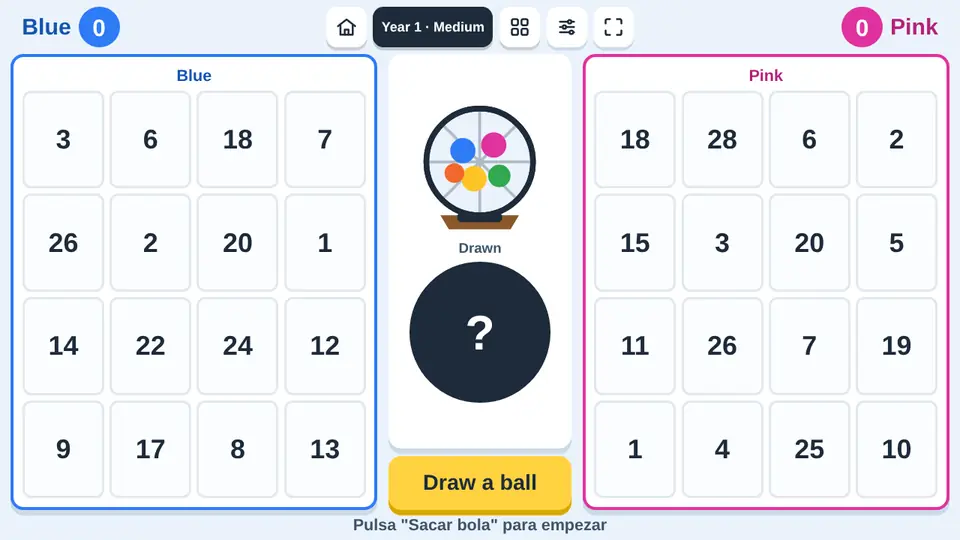
An educational bingo game for the interactive whiteboard. Each team has its own card on its half of the screen. The drum spins, a ball comes out and, if they have it, they tap the square to mark it. Cards can show numbers, coloured shapes, animals or calculations: 7 + 2 comes out and you mark the 9. First comes a line, then bingo.
What children practise
- Recognising and reading numbers up to 20, 30 or 45.
- Mental maths: addition and subtraction, times tables, division, fractions, decimals, percentages and powers, depending on the year.
- Visual discrimination of shapes and colours: circle, square, triangle, star, heart and diamond.
- Animal vocabulary with 16 pictures.
- Rows and columns: spotting when a line is complete.
Levels and settings
Early years
Mixed card: numbers, coloured shapes and animals together.
Y1
A card of numbers up to 50 on Easy and up to 99 on Medium; on Hard, additions (with and without carrying) and subtractions without borrowing up to 99: the ball shows the sum and you mark the answer on the card.
Y2
Three-digit numbers up to 999 on Easy; on Medium, additions and subtractions with carrying up to 99; on Hard, multiplying by one digit too (19 × 3).
Y3 and Y4
Mental maths on the ball: in Y3, times tables, exact divisions and three-digit subtractions (523 − 489); in Y4, dividing by one digit (342 ÷ 6), two digits by one (14 × 6), four-digit subtractions and a half, a third or a quarter of an amount (1/4 of 96). The answer is on the card.
Y5 and Y6
In Y5, fractions of amounts (3/4 of 80), decimals that make a whole number (2.5 × 6), multiplying by 10 and 100, percentages (25% of 240) and dividing by two digits; in Y6, powers (2⁵), square roots (√144), order of operations (6 + 4 × 7), negative numbers (−15 + 43) and percentages. On Easy, the previous year’s calculations come up.
Difficulty
Easy: 3 x 3 card. Medium: 4 x 4. Hard: 5 x 5. In the early years, numbers go up to 20, 30 or 45 depending on the size.
Pace and ending
Balls drawn by hand or automatically every 5 or 3 seconds. Play for line and bingo, or line only when time is short.
How to play it in class
- Open the game and choose the year group and difficulty, or pick the card type, size and pace in the settings.
- Each team gets a different card on its half of the whiteboard.
- Press Draw a ball or let the balls come out by themselves. If a team has it, they tap the square. The balls drawn so far are listed on screen.
- The first full row or column is a line: it scores a point and is highlighted in gold. The game goes on.
- The first team to fill the whole card calls bingo and wins.
Ways to play
In teams, at the same time
The screen splits into 2, 3 or 4 and each team plays on its own part at the same time.
For one player
One child plays on the whole screen at their own pace: on the whiteboard, a computer or a tablet.
Frequently asked questions
Does it work for children who cannot read yet?
Yes. Shape and animal cards need no reading, and in Early years the card mixes numbers, shapes and animals.
How does the calculation bingo work?
The ball shows a calculation, such as 7 + 2 or 12 − 3, and the answer, 9, is marked on the card.
Can I decide when each ball comes out?
Yes. With the manual pace, a ball only comes out when you press Draw a ball, so you can wait until everyone has checked their card.
Is it free?
You can play 5 free games without signing up. After that, a one-off payment of €9.99 unlocks all 100 games for ever, on all your devices. There is no subscription.
Do I need to install anything?
No. It opens in the browser of the interactive whiteboard, panel, computer, tablet or iPad. Once loaded, it also works offline.
More Maths games
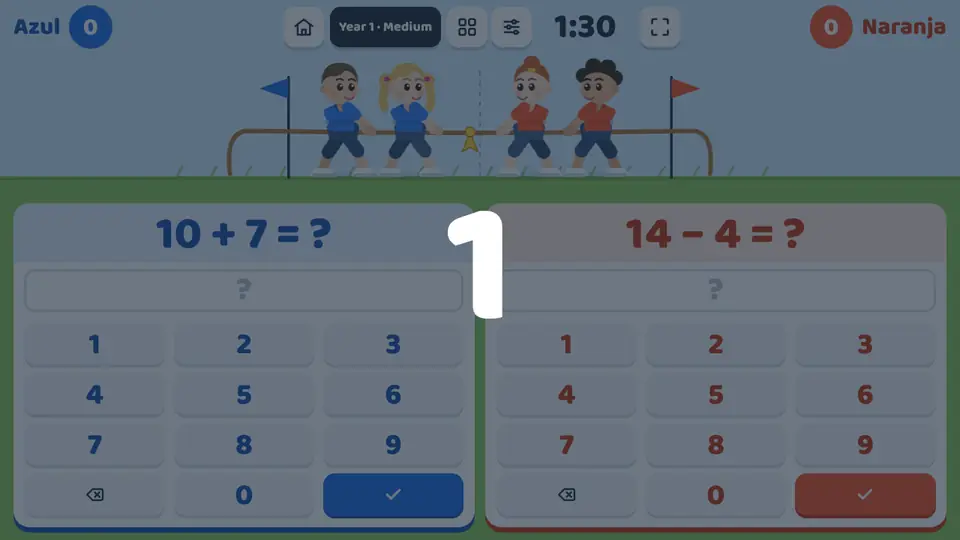 Tug of warA mental maths game for the interactive whiteboard with the screen split in two: each team gets its own number pad and its own calculation.
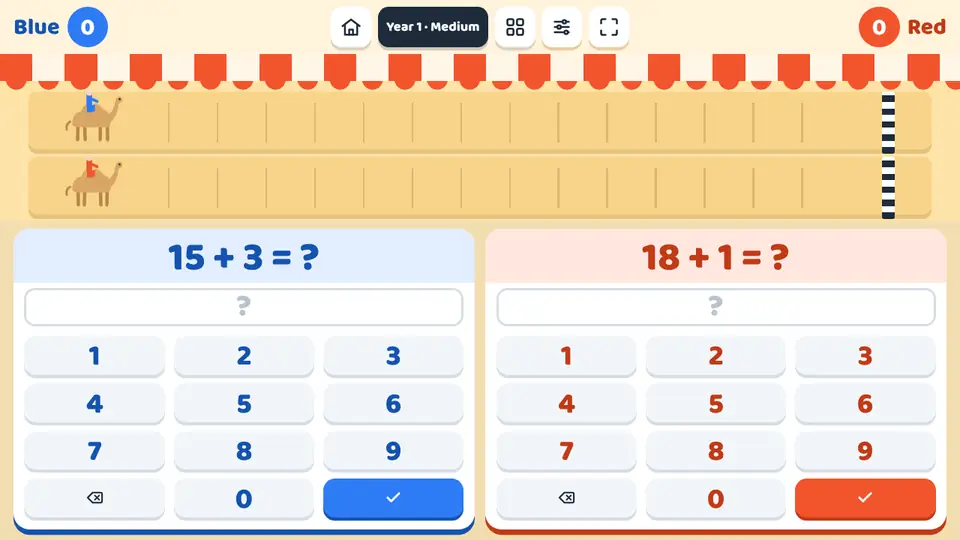 Camel raceA fairground stall turned into a maths game for the interactive whiteboard.
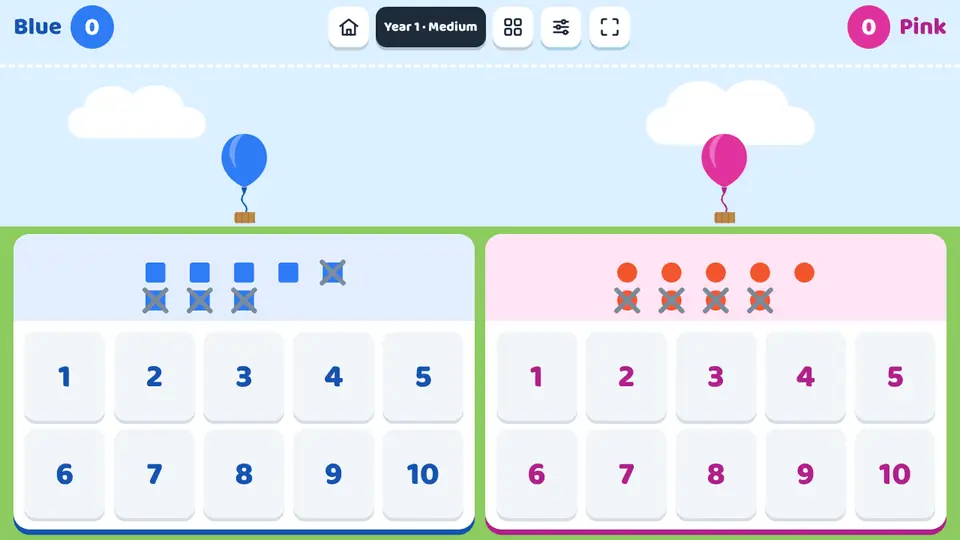 Balloon raceA counting game for the interactive whiteboard designed for children who cannot read yet.
 Block towerTwo towers grow side by side on the interactive whiteboard, one per team.
Bingo
Play now